No! we don’t serve Spaghetti Bolognese here. This is Bologna-it’s ragù
JAN 07, 2023
What Is Italian Food, Really?
“No such thing as ‘ancient Italian cuisine,’” Alberto Grandi once declared, and yes, he’s ruffled more than a few aprons. Grandi, food historian and professor at the University of Parma, argues that much of what we call traditional Italian food is…modern. According to him, dishes like carbonara, panettone, and even some Parmigiano Reggiano are post-WWII inventions—or heavily reinvented. The idea of a unified “Italian cuisine” is largely a 20th-century construct, a way to forge a national identity. In his words, many culinary “traditions” are fairy tales.
It’s provocative, sure. But as I stare down a steaming bowl of Tagliatelle al ragù in Bologna, I don’t care whether it’s 50 years old or 500. Tradition here is measured not in decades, but in obsession.
Italian food is seasonal, local, and fiercely tied to place. What you eat in April isn’t what you eat in December. Easter is different from Christmas. Recipes vary by town, by grandmother, by family. And heaven help you if you argue about ragù in Bologna. I’ve witnessed debates—lively, aggressive, and just a touch combative—about the “correct” method. “Cosa fai con il ragù?!” someone exclaimed once, aghast at a less-than-orthodox approach.
And yes, let’s get it out of the way: spaghetti Bolognese does not exist here. At least, not as you imagine it. Italians roll their eyes when tourists ask for it. In Bologna, it’s ragù, and it belongs on tagliatelle. Thin, wide ribbons, not spaghetti. Sauce clinging perfectly to pasta, not drowning it like some overenthusiastic American adaptation. Opinions are like…well, you know.
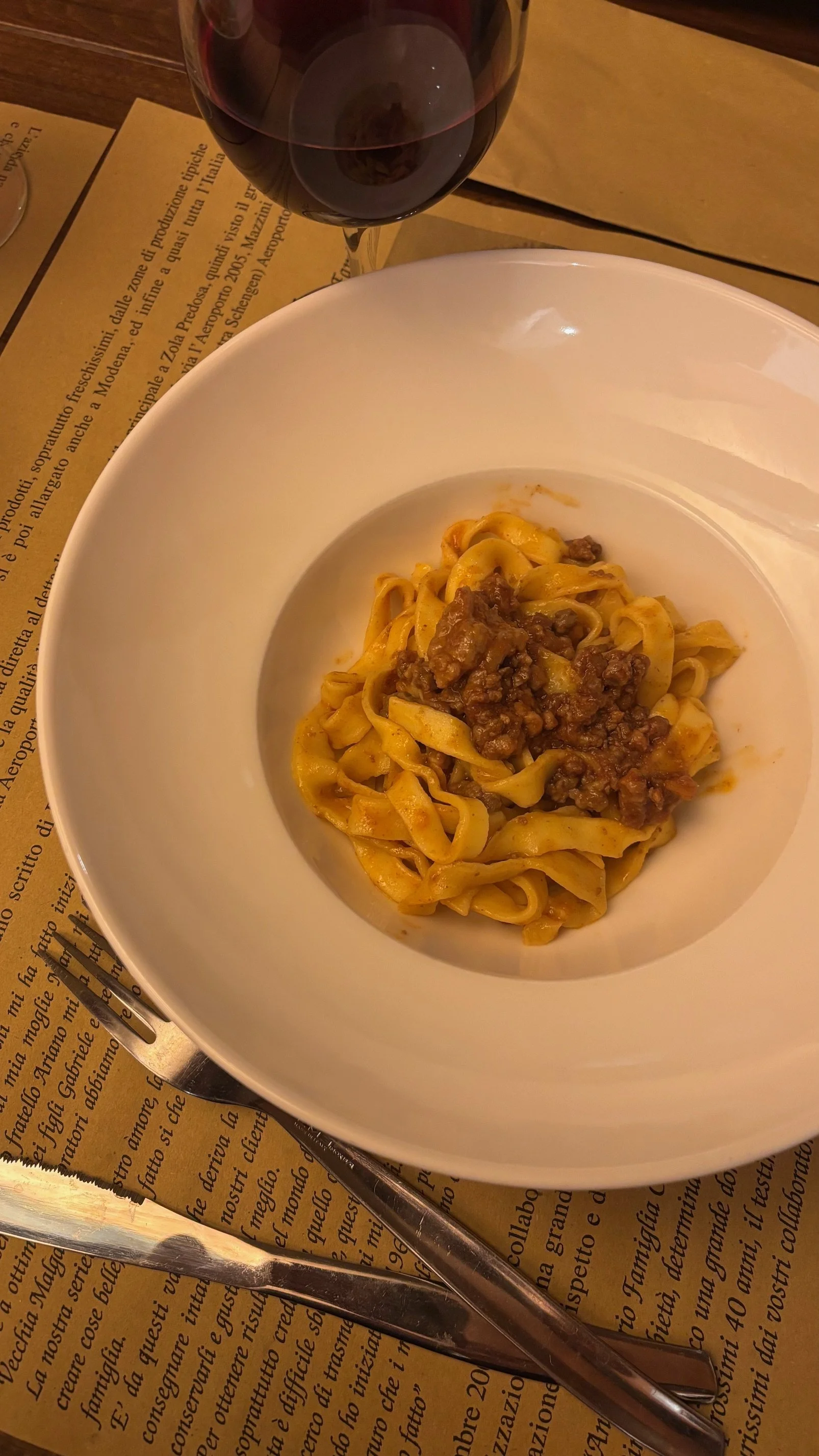
Tagliatelle al ragù
The universal truth? Ask any Italian where to get the best Tagliatelle al ragù, and the answer is always the same: Mia mamma. Always.
Food here isn’t just sustenance—it’s identity, pride, and obsession. Everyone, rich or poor, considers where ingredients come from, who made them, and how they’re prepared. Even supermarket staples are leagues above what you’ll find in America. In Emilia-Romagna, a tiny osteria can serve Gramigna alla salsiccia, Tortelloni burro e salvia, or Passatelli for €7.50—and it will often outperform a pricier restaurant. Simplicity, executed flawlessly, is the region’s secret.
As an Australian-American chef living in Bologna, I chase these interpretations of classics. Tagliatelle al ragù is obsessive craftsmanship: fresh pasta rolled and folded by hand every day, boiled in salted water, tossed with a sauce rich with local meats, soffritto, wine, and passata, and finished with Parmigiano Reggiano. Each bite carries the story of hills, farms, kitchens, and the people who nurtured them—regardless of whether Grandi would call it a “modern invention.”
At Amerigo 1934, where I worked, Chef Alberto Bettini takes this devotion to a level bordering on reverent. The ragù is crafted from Vacca Bianca cows and Mora Romagnola pigs, with a soffritto, white wine, and passata. Roberta or Anna roll the pasta using flour ground at a 16th-century mill nearby. Tagliatelle hits the pan with just a touch of butter; Parmigiano is added at the very end. Rich, robust, irresistible. Every bite tastes of place, labor, and love.
Bologna is dotted with trattorie and osterie serving this dish. Grassilli, tucked down a cobblestone alley, delivers tiny salumi misti and ragù that sing. Trattoria da Me and Salsamentaria are comforting staples. Even in the tourist-heavy Quadrilatero, bowls for €9–€11 outperform more elaborate or expensive plates elsewhere.
Grandi might call it modern. But here, in kitchens, markets, and on the tables of mothers and restaurateurs, tradition is alive, spirited, and delicious. And just to be clear: no spaghetti. None. Tagliatelle only. Spaghetti Bolognese is a myth, a culinary chimera invented far from these hills.
So, if you’re here for the first time, relax. Take it all in. Surrender. To tagliatelle. To ragù. To obsession. And to the joy of eating like an Italian, whether it’s 50 years old or 500